

Eligibility and Enrollment
Understand your Medicare eligibility and the important enrollment periods so you can make the right choices for your health and future.
- Know if you qualify for Medicare
- Understand enrollment periods
- Avoid late enrollment penalties
- We're here to help every step of the way
Based on Age, Disability or Medical Condition
You may become eligible to receive Medicare benefits based on your age, disability, or medical condition.
Initial Enrollment Period (IEP)
The Initial Election Period is the first time you may enroll into Medicare. This is a 7-month long window that surrounds your birthday, or the 25th month of receiving disability benefits.
Special Enrollment Period (SEP)
Medicare beneficiaries that missed their enrollment period or have a qualifying life event may be eligible for a Special Enrollment Period.
Plan Enrollment Periods
Members of Medicare Advantage, Medigap, or Prescription Drug Plans have specific enrollment periods that allow them to enroll, disenroll, or switch their plan.
Am I eligible for Medicare?
Medicare is the federal health insurance program that is available to U.S. citizens and to legal residents who have lived in the United States at least 5 years in a row. You may become eligible to receive Medicare benefits based on your age, disability, or medical condition. How to qualify through these three criteria are as follows:
Age 65 or Older
Generally, you must be 65 years old to qualify for Medicare. Medicare is an individual policy. This means that it does not cover spouses or dependents.
If you’re working at 65 or older, you may defer Medicare Parts A and/or B if you have existing qualifying group coverage, such as from an employer. It’s important to consider the cost and coverage when you have these options, as Medicare options could cover more and cost less. See Medicare Vs. Employer coverage
Disability Under 65
If you are under 65 years old and disabled, you qualify for Medicare once you’ve been collecting social security disability for 24 months. At the start of the 25th month, you will automatically be enrolled into Original Medicare.
Any Marketplace/Obamacare coverage you may have will need to end, as you are no longer eligible to collect a subsidy from the government to help pay for your health insurance premium, once you are Medicare eligible.
If you remain on Marketplace coverage after becoming Medicare eligible, you are responsible for paying back all of the premium tax credit that was applied to your premium – only for the months that you were eligible for Medicare.
Medical Conditions
Individuals with Lou Gehrig’s disease (ALS) or End-Stage Renal Disease (permanent kidney failure requiring dialysis or a transplant, sometimes called ESRD) automatically qualify for Medicare.
We're Here to Help You!
Have questions or need personalized guidance? Fill out the form and one of our experts will get back to you.
When can I enroll into Medicare?
There are only certain times when people can enroll into Medicare. Depending on the situation, some people get Medicare Part A (Hospital Insurance) and Medicare Part B (Medical Insurance) automatically and other people have to sign up for it. In most cases, it depends on whether you’re getting Social Security benefits.
If you haven’t already, check out our “Getting Started with Medicare” first to learn how to sign up for Medicare. The first time you can enroll is called your Initial Enrollment Period.
Your IEP is 7 months long and happens around your 65th birthday or the 25th month of receiving Social Security disability benefits if you’re under 65 years old. It’s important to act during your IEP. You’ll have some decisions to make, even if you have other insurance. Learn more
AEP begins October 15th and ends December 7th every year. During this period, individuals already enrolled in Medicare may enroll, change, or disenroll from a Medicare Advantage plan (Part C) or Part D drug plan. This is a crucial period for Medicare beneficiaries. Learn more
General Enrollment Period (GEP)
The General Enrollment Period is like make-up time. It’s when you can enroll in Medicare if you didn’t sign up during your Initial Enrollment Period. The GEP is January 1st – March 31st every year. You may have to pay a Part B penalty for late enrollment. Coverage takes effect on the first of the following month.
Open Enrollment Period (OEP)
The Open Enrollment Period also runs from January 1st – March 31st every year. However, the purpose is different than the General Enrollment Period. Existing Medicare Advantage members may (1) change their plan or (2) cancel their Medicare Advantage plan and return to original Medicare with a Prescription Drug Plan. Medicare Advantage members that changed their plan during the Annual Enrollment Period or missed it often use this period to their advantage.
A Medicare Special Enrollment Period (SEP) allows you to enroll in Medicare or change your Medicare coverage outside of the standard enrollment periods without penalty. There are different SEPs that apply in specific circumstances, and each has its own rules about timing. Learn more
Medigap Open Enrollment Period
Medicare Supplement insurance, or Medigap, may be added to Original Medicare at any time after you’re enrolled in both Part A and Part B, but you have “guaranteed issue rights” only at certain times.
This enrollment period gives you 6 months from your Part B effective date to enroll into a Medigap plan without answering health questions. With enough planning, you’re able to start your Medigap plan the same day as your Part B effective date.
Initial Enrollment Period (IEP)
For individuals aging into Medicare, this is the most important enrollment period. This gives beneficiaries their first chance to enroll into Medicare.
The Initial Enrollment Period, or IEP, is a 7-month period that includes the three months before your birth month, your birth month, and the three months following. For example, if you turn 65 on June 4th, your IEP will start March 1st and end September 31st.
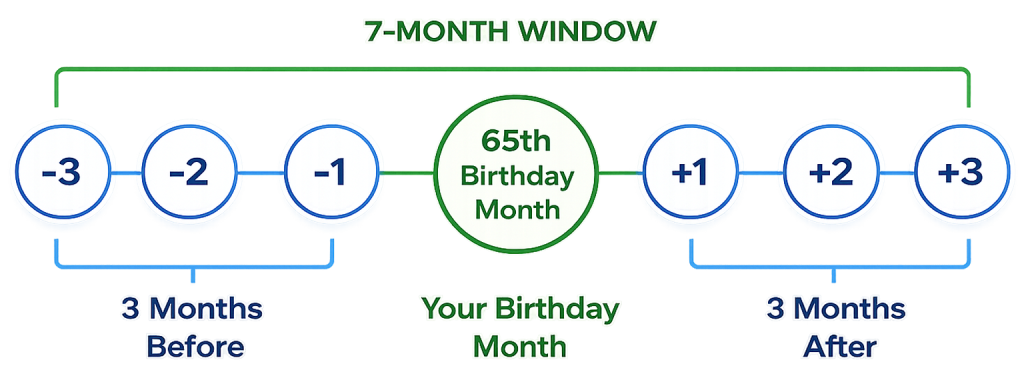
There is one exception to this rule: If you have a birthday on the first of the month, your IEP and eligibility for enrollment starts one month early. For example, if your 65th birthday is on December 1st, your IEP will start August 1st and end February 31st. You’re eligible to start Medicare on November 1st, one month early.
For this period: You’re eligible to enroll into Original Medicare, as well as Medicare Advantage, Medigap – guaranteed issue, or a Prescription Drug Plan. For most individuals, they will need to sign up for Medicare during their Initial Election Period to avoid a late enrollment penalty.
Use this IEP calculator for any clarity on the matter.
Your Results are Listed Below!
Your Medicare Enrollment Period Starts on:
And it Stretches From:
⇄
✅
Your Month-by-Month Timeline
3 months before birthday
Birthday month
3 months after birthday
*Since your birthday falls on the 1st of the month, your eligibility starts one month early!
Annual Enrollment Period (AEP)
This is the most crucial enrollment period for individuals that are on either a Medicare Advantage plan or Prescription Drug Plan (PDP), Part C and Part D.
During this period, those individuals listed above may change their plan or cancel their plan to return to Original Medicare. This runs every year from October 15th to December 7th.
In October, Medicare Advantage and PDP’s send out an Annual Notice of Change, or ANOC. This ANOC reviews all changes to your plan benefits for the following year. Based on what you see, you then have the choice to either remain on your current plan or switch plans. Members that switch their plan will have their new plan begin January 1st of the following new year.
Special Enrollment Period (SEP)
Medicare beneficiaries that wish to join Medicare Advantage or Prescription Drug Plans mid-year or would like to switch their current plan must qualify for a Special Enrollment Period, or SEP.
The type of plan changes you’re allowed depend on your life event or situation. Most events create a 2-month window, or SEP, that allows an individual to make changes to their plan. Failure to make Medicare changes during this 2-month period may result in an inability to make plan changes or may subject you to late enrollment periods.
Common SEP’s include moving to a new address that is outside you plan service area, ending group employer coverage, losing/gaining Medicaid or Extra Help, or you have a severe or disabling condition that allows you to switch to a Chronic Special Needs Plan (C-SNP).
Some SEP’s grant you “guarantee issue rights” to a Medigap plan, although this special circumstance varies by state.
To see a full list of Special Enrollment Periods approved by Medicare, please check with one of our agents or check here at Medicare.gov.
Frequently Asked Questions Regarding Eligibility and Enrollment
Would I be subject to a late enrollment period if I was on my employer coverage past 65?
No! If this was credible group coverage (Larger than 20+ employees), you will qualify for a Special Enrollment Period when you decide to end your employer coverage and move to Medicare and its supplemental options.
What are “guaranteed issue rights”?
This refers to your eligibility to Medigap, otherwise known as Medicare Supplement. When you turn 65, or begin your Part B of Medicare, you receive guaranteed issue rights to join a plan. You’re able to enroll with no health questions asked or underwriting.
I had no idea about my Initial Enrollment Period and I missed it - What happens now?
If you missed your Initial Enrollment Period, you may unfortunately be subject to a late enrollment penalty for Part B medical and/or Part D prescription drug coverage. To check your penalty amount, use the Part B penalty calculator and Part D penalty calculator. Penalties are present for as long as you have the coverage!
Your next available enrollment period is the General Enrollment Period. Once you start your Part A and B of Medicare, we can help you find a supplemental plan that fits your needs and budget.
I have been collecting disability for almost 2 years, when can I sign up for Medicare? Do I have to accept Medicare?
The Social Security office will reach out when it’s time to turn on Medicare, typically about 3 months away from your 25th month of collecting disability. Your start date will be on the 1st day of your 25th month.
Once you become eligible for Medicare through disability, you must accept if you don’t have other qualifying coverage. Most commonly, other qualifying coverage may refer to a spouses group employer insurance. Marketplace coverage does not qualify and if you are collecting a subsidy for Marketplace/Obamacare insurance, you will be responsible for paying back all the subsidy you received for however many months you were also eligible for Medicare.
To return to our Medicare checklist, click here
Part B Penalty Calculator
If you missed your Medicare Part B deadline, you might have to pay a lifelong late fee. Enter how many months you delayed to see your estimated penalty.
✅ Good News!
Because you delayed for less than 12 full months, Medicare does not charge you a Part B penalty.
Because you delayed for less than 12 full months, Medicare does not charge you a Part B penalty.
⚠️ Penalty Estimate: added to your monthly bill for life.
How we calculated this:
Medicare charges a 10% penalty for every full 12-month period you were late.
• You were late for full year(s).
• year(s) × 10% = penalty.
• of the standard premium ($202.90) is approx .
Medicare charges a 10% penalty for every full 12-month period you were late.
• You were late for full year(s).
• year(s) × 10% = penalty.
• of the standard premium ($202.90) is approx .
Part D Penalty Calculator
If you went without a prescription drug plan for too long, Medicare adds a lifelong fee. Enter your uncovered months below to check your penalty.
✅ Good News!
Since your coverage gap was under 63 days (about 2 months), you do not owe a Part D penalty.
Since your coverage gap was under 63 days (about 2 months), you do not owe a Part D penalty.
⚠️ Penalty Estimate: added to your monthly bill for life.
How we calculated this:
Medicare charges a 1% penalty for each full month you went without coverage.
• You went months without coverage.
• months × 1% = penalty.
• of the national base premium ($38.99) is approx .
Medicare charges a 1% penalty for each full month you went without coverage.
• You went months without coverage.
• months × 1% = penalty.
• of the national base premium ($38.99) is approx .